

Independent restaurants are not short on marketing moments. They are short on time, structure, and connected workflows. The best signals often happen during service: a guest asks for a dish twice, the patio fills early, a new staff pick gets reactions, a review names a detail the team should repeat, or a slow hour needs a sharper reason to visit.
A manager sees those moments first. The problem is that the signal usually stays trapped in the shift. It may live in a text thread, a memory, a notebook, or a quick comment at close. By the time someone sits down to market it, the moment is old or the owner is already dealing with tomorrow.
The manager marketing loop fixes that. It turns one operational note into clear local demand actions: a Google update, a social post, an email prompt, a review response, a direct-order nudge, or a next-day offer. The restaurant does not need another content chore. It needs a way to use the context it already has.
Why this matters now
Staffing pressure has made manager time more valuable. Operators are thinking harder about retention, training, and the ROI of every system they add. At the same time, guests are discovering restaurants across more surfaces than ever: Google, social media, reservation apps, delivery apps, review sites, and AI-assisted recommendations.
That creates a difficult gap. The restaurant has fresh context every day, but the public channels often lag behind reality. Google may not show the current reason to visit. Social may miss the strongest moment. A good review may sit unanswered. A direct-order opportunity may not get a follow-up.
The answer is not to ask managers to become social media managers. The answer is to make a manager note useful across the whole marketing system.
What belongs in the loop
A useful shift note is short, specific, and tied to action. It might say: patio filled from 5 to 7, guests asked about family meals, staff pick moved at lunch, delivery add-ons were low, review praised service speed, or Tuesday needs a reason to come in.
Each note should map to a next step. A staff pick can become a post. A quiet hour can become a limited offer. A review can become public proof. A repeated guest question can become a Google update. A direct-order drop can become a reminder.
The loop is simple: capture the signal, choose the channel, publish the action, and measure the response. When this happens consistently, local marketing stops feeling like a separate job and starts behaving like part of operations.
How to start without overloading the team
Pick one manager note per day. Do not start with a full content calendar. Ask for one sentence after a key service window: what happened today that guests should know about tomorrow?
Use a simple set of categories: offer, proof, timing, review, staff pick, guest question, or follow-up. That keeps the note from becoming a long report.
Then create one action. If the note is about a staff pick, post it and add a direct next step. If the note is about a slow hour, create a specific reason to visit. If the note is about a review, respond publicly and turn the insight into a reminder. If the note is about a repeated question, update the answer where guests search.
Finally, measure one result. Did the post get saves? Did the direct link get clicks? Did the review response help local proof? Did the offer move the daypart? The goal is not perfect attribution. The goal is a visible rhythm the owner can improve.
Where KitchenRush fits
KitchenRush is built for independent restaurants that cannot afford a separate agency, social manager, local SEO specialist, guest messaging tool, and operations stack. It helps operators capture restaurant context once, then route it into the channels that shape demand.
A manager note should not disappear at close. With the right workflow, it can become tomorrow's reason to visit, this week's review proof, or the next direct-order reminder. That is how independent restaurants stay visible without adding another layer of work.
CTA
Use KitchenRush to turn daily restaurant context into consistent local demand.
Visual version
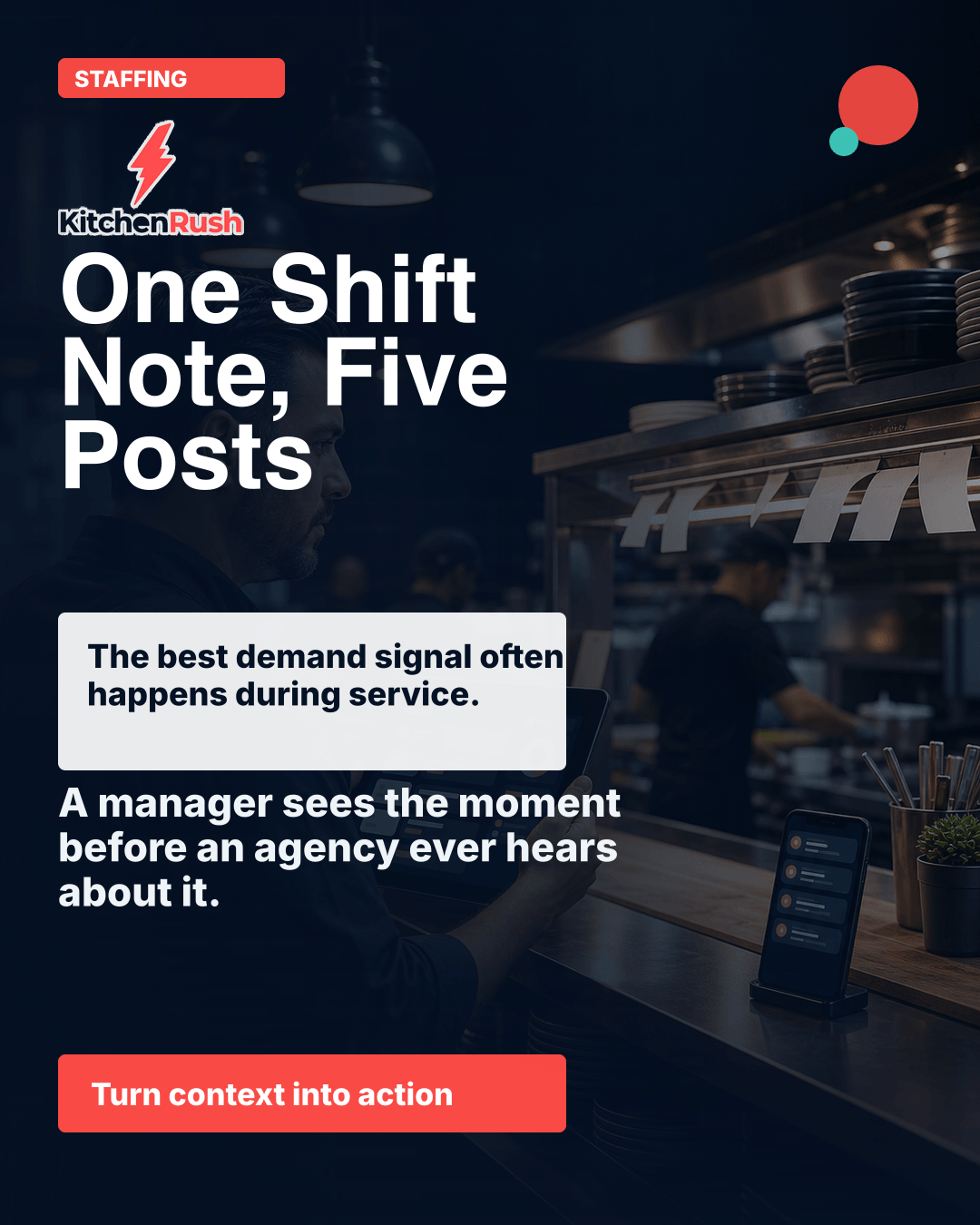
Carousel companion for the same topic.