Restaurants Need a Short-Form Clip Queue
Short-form video has become one of the most practical local marketing tools available to independent restaurants. The problem is not that owners doubt the value of Reels, TikToks, Shorts, or behind-the-scenes content. The problem is that the day is already full. Prep starts early, phones ring, staff need answers, guests need service, and the owner is still expected to post like a media team.
The answer is not to turn every shift into a production shoot. The answer is a clip queue: a small, repeatable system for capturing real service moments and turning them into a steady stream of local content.
Why the clip queue matters now
Restaurant discovery is increasingly social. Later notes that younger audiences are bypassing traditional search and using Instagram, TikTok, and Reddit for recommendations, tutorials, and local spots. Bar & Restaurant coverage points to Gen Z and Millennials looking for short-form video, authentic behind-the-scenes content, social proof, and digital-first communication.
At the same time, audiences are tired of generic brand output. Sprout Social reported that only 56% of social users say brands do a good job producing truly original content. For restaurants, that is an opening. The original content is already there: the owner checking the board, the first plate of lunch, the team getting ready before doors open, the handoff at the counter, the thank-you after a busy night.
A restaurant does not need to invent a personality from scratch. It needs to capture the moments that prove the place is alive.
The owner problem
Most independent restaurants do not fail at social because they lack content. They fail because the content is not organized. A good video gets filmed, sits on someone's phone, and never becomes a post. A great review arrives, but nobody pairs it with a clip. A seasonal offer gets mentioned once and disappears. A busy night creates proof of demand, but the restaurant has no system to reuse it.
That is why the clip queue is different from simply saying, "post more videos." A queue turns capture into a workflow. It gives the owner and team a short list of moments to record, a place to store them, a caption path, a schedule, and a way to reuse the best clips across channels.
What belongs in the queue
The strongest restaurant clips are usually simple. They show the restaurant doing what it already does well. A good clip queue might include prep, plating, pouring, packaging, staff greetings, order handoffs, owner notes, review thank-yous, limited-time offers, neighborhood reminders, and quick answers to common questions.
The goal is not perfection. It is clarity. Guests want to know what the place feels like, what is worth ordering, whether the team cares, and whether the business is active. Short-form video answers those questions faster than a polished paragraph.
Each clip should have one job. Show the room. Show the product. Show the people. Show the offer. Show the proof. Show the next step. If a clip tries to do everything, it becomes noise.
From one clip to many channels
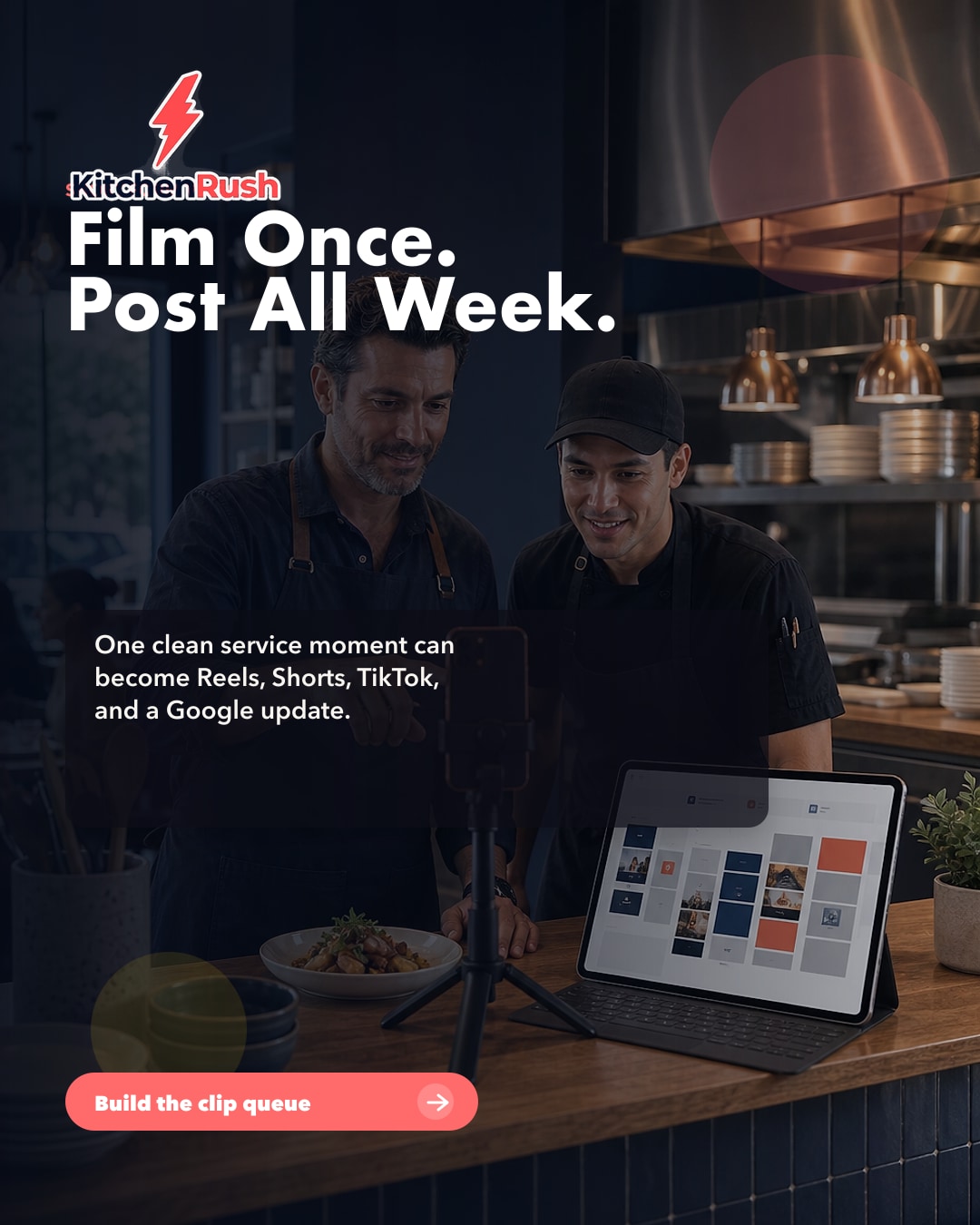
A useful clip can travel farther than one post. The same service moment can become an Instagram Reel, a TikTok, a YouTube Short, a Facebook Reel, a Google Business Profile update, an email image, and a neighborhood offer reminder.
That matters because local guests do not all discover restaurants the same way. Some search Google Maps. Some check Instagram. Some see a video shared by a friend. Some respond to email. Some need a direct order link. A clip queue lets the owner reuse the same authentic moment without rewriting the whole marketing plan every time.
Google also encourages businesses to add photos and videos to Business Profiles and keep information complete and accurate. That means a video habit can support both social discovery and local search visibility when it is connected to the rest of the marketing workflow.
How to build the weekly rhythm
Start with three capture prompts per week. One should show product or service. One should show people or process. One should show proof, such as a guest reaction, review theme, busy moment, or owner thank-you.
Keep each raw clip short. Ten to twenty seconds is enough. Film vertically. Keep the subject centered. Avoid loud background chaos when someone is speaking. Capture clean light whenever possible. Do not wait for a perfect day. A consistent queue beats a rare perfect shoot.
Then assign each clip a purpose before it is posted. Is it meant to drive pickup orders? Build trust? Promote a weekday offer? Remind guests about hours? Support a Google update? Thank the neighborhood? The caption, CTA, and platform choice should match that purpose.
Finally, review what worked. Saves, shares, comments, calls, direct orders, profile visits, and Google actions all tell the owner something. The next week's queue should learn from that signal.
How KitchenRush helps
KitchenRush helps independent restaurant owners turn marketing from a scattered chore into one connected workflow. Instead of filming a clip, forgetting it, writing captions from scratch, and logging into multiple platforms, the owner can plan, caption, schedule, publish, and connect follow-up from one portal.
The bigger value is operational. Content should not sit apart from the business. It should connect to offers, reviews, Google updates, email, direct ordering, and neighborhood visibility. When the same system sees the marketing calendar and the restaurant's demand signals, the owner can publish with more intention.
A short-form clip queue gives the restaurant consistency. KitchenRush gives that consistency somewhere to run.
FAQ
What is a restaurant clip queue?
A clip queue is a repeatable list of short videos a restaurant captures, captions, schedules, and reuses across social, Google, email, and local marketing channels.
How often should a restaurant film clips?
Start with three short clips per week. Once the habit is easy, capture one clean moment per shift and use the best clips for planned posts.
Does short-form video need professional production?
No. Clear light, centered framing, real staff moments, and a single message usually matter more than a full production setup.
Which platforms should restaurants use?
Most independent restaurants should think in terms of reuse: Instagram Reels, TikTok, YouTube Shorts, Facebook, Google Business Profile, email, and the website when relevant.
How does KitchenRush make this easier?
KitchenRush helps owners plan, caption, schedule, and publish content while connecting it to reviews, offers, local search, email, and direct ordering.
Make visibility a rhythm
The restaurants that stay visible are not always the ones with the biggest production budgets. They are the ones with a practical habit. Capture the real shift. Queue the useful moments. Publish with a purpose. Repeat until local guests start seeing the restaurant everywhere they already look.
Visual version