

Guests do not discover restaurants in one place anymore. They see a Reel from a friend, search TikTok for a neighborhood dish, check Google Maps, scan photos, compare reviews, look for the menu, and then decide whether the restaurant feels worth the trip. The decision path is fragmented, but the guest experience still feels instant.
That is why short-form video is no longer just a social media tactic. For independent restaurants, it has become local discovery infrastructure. A strong clip can make a dish feel current, show the room is alive, answer a menu question, and give the guest a reason to choose the restaurant tonight.
Current social research keeps pointing in the same direction. Sprout Social's 2026 social reporting focuses heavily on social search and brand responsiveness. Toast's restaurant social media guidance continues to frame platforms like Instagram, TikTok, Facebook, and X as places where guests spend time and discover restaurants. Toast's diner research also found that TikTok is especially influential for younger diners choosing where to eat.
The lesson is not that every restaurant needs to become a media company. The lesson is that local demand now rewards restaurants that can show what is happening today, publish it in the right format, and connect that attention to a direct next step.
Short-form content gives proof faster than copy
A menu description can tell a guest what is available. A short clip can show pace, portion, texture, freshness, staff energy, and the feeling of the room in a few seconds. That matters because local dining decisions are emotional and practical at the same time.
Guests ask themselves: does this look good, is it nearby, does it feel open, can I order it, and do other people seem to trust it? Short-form content answers several of those questions before the guest clicks.
For independent restaurants, the strongest clips are usually simple. A fresh item coming off the line. A server setting down a lunch special. A quick look at the dining room before service. A close-up of a dish that is actually available today. A manager explaining a weekend offer in one sentence. A behind-the-scenes moment that makes the restaurant feel human.
The mistake is trying to make every post cinematic. The goal is not a commercial. The goal is useful proof that travels.
Social search works best when it is connected
Posting a clip is only one part of the job. The restaurant also needs the rest of the local presence to agree with it.
If the clip promotes a weekday offer, the link should lead to a clear menu or ordering path. If the clip shows a seasonal item, Google photos and the website should not look stale. If comments ask whether the item is available, the restaurant needs a fast answer. If guests save the post, the restaurant should be ready to turn that attention into an order, booking, or return visit.
That is where many independent operators get stuck. They can create a good clip, but the follow-through is spread across too many tools: Instagram, TikTok, YouTube Shorts, Facebook, Google Business Profile, the website, the ordering link, the review stack, the email inbox, and maybe a scheduling app.
Social search is powerful, but it punishes disconnected operations.
The weekly content stack
Restaurants do not need to invent a new campaign every day. A practical weekly stack can carry most of the load.
Start with one anchor moment. Choose something guests can act on this week: a lunch item, a dinner special, a catering slot, a happy-hour window, a seasonal drink, a private-event opening, or a neighborhood partnership.
Capture one vertical clip. Keep it short, bright, and specific. Show the dish, the room, the offer, or the team member. Avoid vague mood content that does not help the guest choose.
Turn the clip into five placements. Publish it as a Reel, TikTok, Short, Facebook post, and Google update when appropriate. Use the same core idea, but adjust the caption to fit the platform.
Add one still image. A clean still helps with X, Google, LinkedIn, and any place where a video is not the best default.
Connect the next step. Use a direct-order link, booking link, offer page, or learn-more path. The guest should never have to search again after the post earns attention.
Review the signal. Which platform got saves, comments, clicks, calls, or orders? The answer should shape next week's post.
What to post when time is tight
The best restaurant content system respects the operator's time. If the team only has ten minutes, capture the moment already happening.
Before service, film the prep or the room reset. During a quiet window, show the offer that can fill the next shift. After service, capture a thank-you clip, a staff pick, or a reminder for tomorrow. If the restaurant has no bandwidth for video, use one sharp still and a clear reason to visit.
The important part is consistency. Guests should not land on a profile that looks abandoned. Search engines and social platforms both reward signals that the business is active, responsive, and relevant. More importantly, guests reward it. They feel more confident choosing a restaurant that looks alive.
Where KitchenRush fits
KitchenRush helps independent restaurants turn short-form attention into a connected local marketing workflow. Operators can plan content, publish across channels, keep Google Business Profile active, connect posts to direct ordering or booking, and track what actually moves demand.
That consolidation matters because the owner should not need five separate tools to publish one lunch clip and learn whether it worked. The platform brings the work closer to the way restaurants actually run: fast, local, practical, and tied to the next shift.
Social search starts dinner. The restaurants that win are the ones that make it easy for the guest to go from seeing the moment to choosing the restaurant.
Visual version
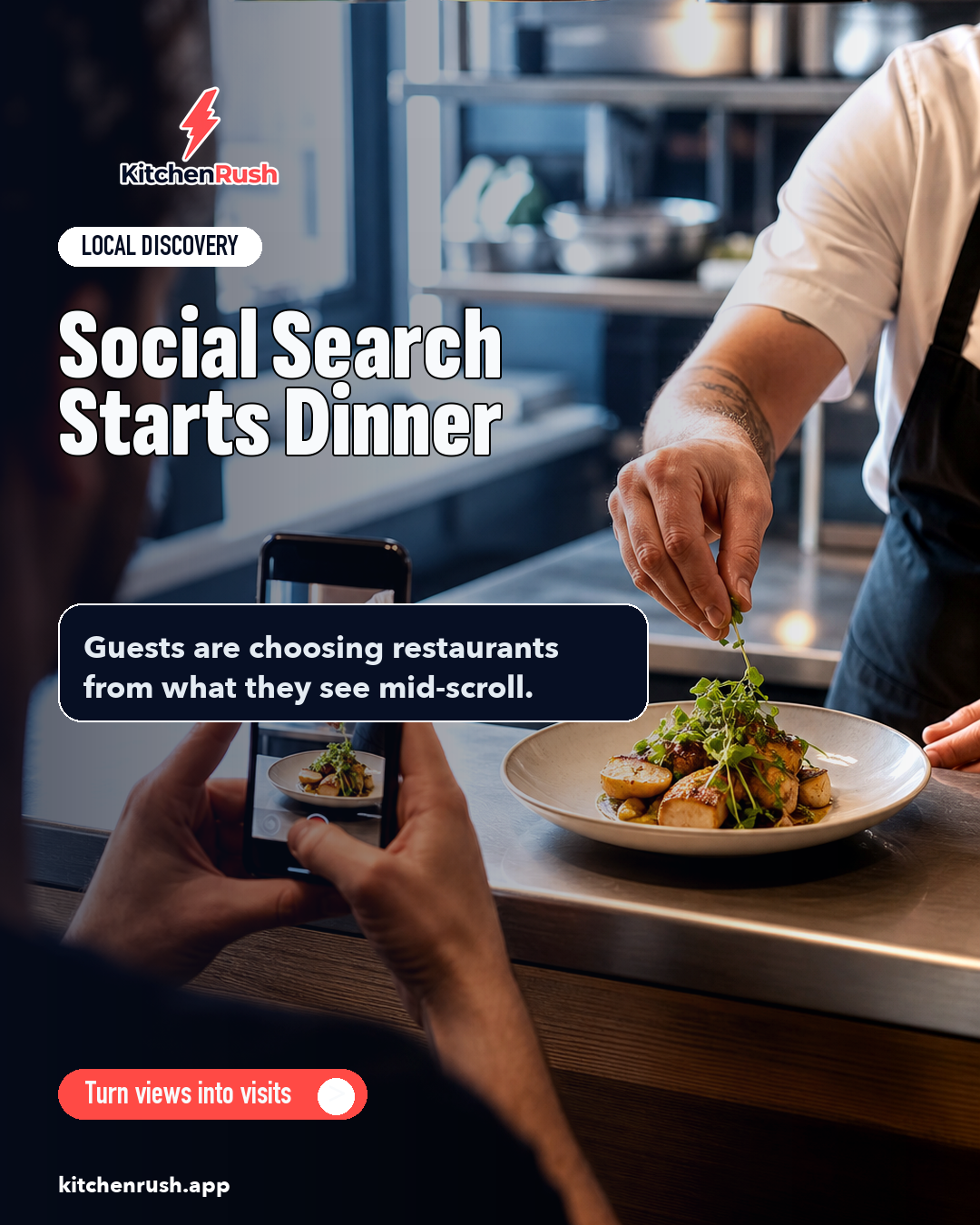
Carousel companion for the same topic.