Your Best Customers Aren't Leaving Reviews. That's the Real Problem.
TL;DR: The average independent restaurant has reviews from fewer than 2% of its customers. The unhappy ones are three times more likely to post than the happy ones (Spiegel Research Center, Northwestern). That means your Google rating — the number that determines whether a stranger picks you or the place next door — is being written by the angriest sliver of your customer base. The fix isn't responding to bad reviews. It's systematically capturing the silent majority.
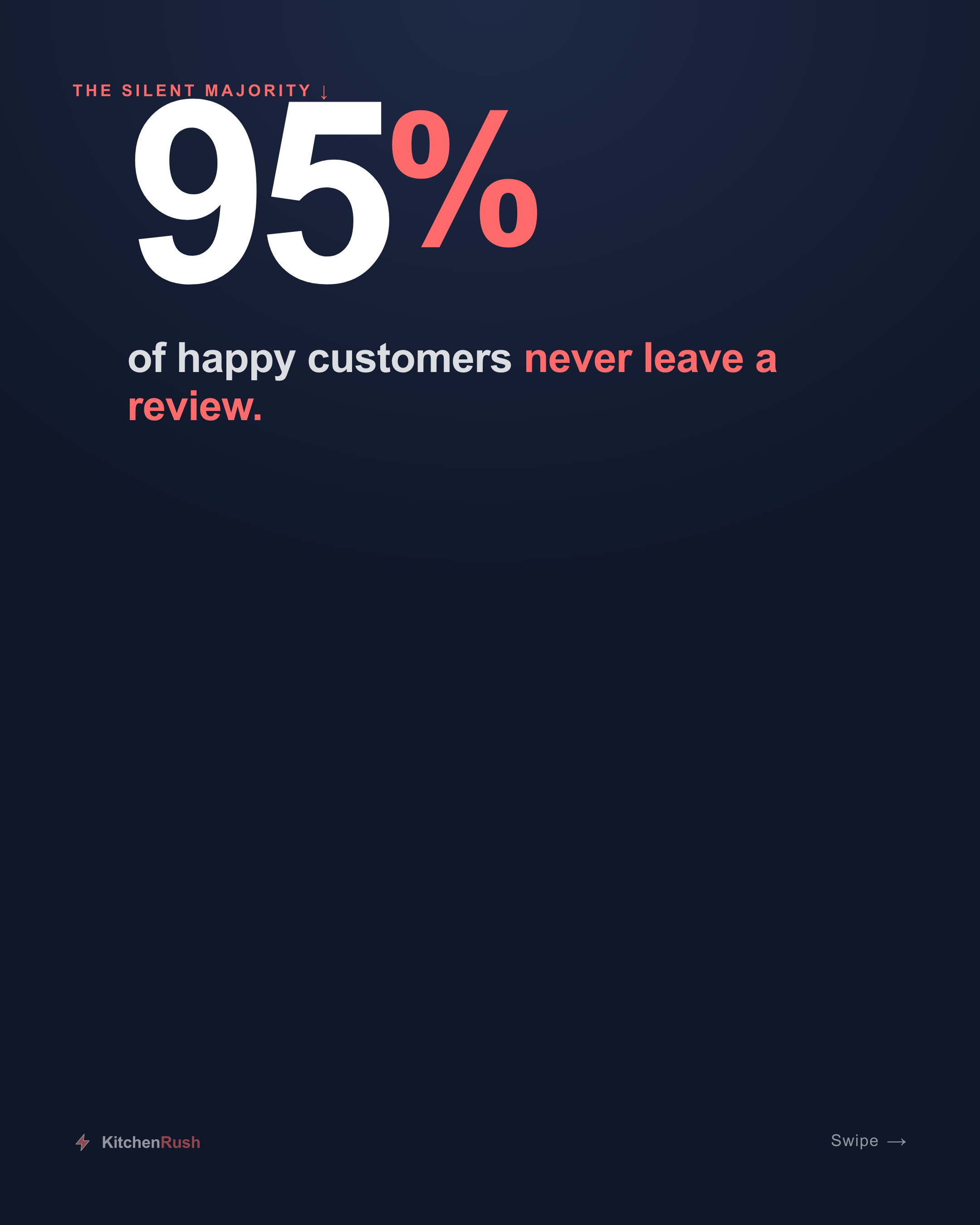
Here's a number that should bother you: BrightLocal's 2024 Local Consumer Review Survey found that only 5–10% of customers who have a positive experience will leave a review unprompted. Meanwhile, customers who have a negative experience are roughly three times more likely to write one (Spiegel Research Center, Northwestern University).
Do the math on your own place. If you serve 200 customers a week and 190 of them leave happy, maybe 10–19 of those happy customers will ever think about reviewing you. But the 10 who had a bad night? Three to five of them will post — and they'll do it the same evening, while they're still annoyed.
Over six months, that ratio compounds. Your Google profile slowly drifts toward the voice of your worst nights, not your best ones. And the stranger searching "places to eat near me" at 6:45 PM doesn't know the difference.
The star rating isn't the whole story
Most owners fixate on the star number. A 4.2 feels worse than a 4.6, and a 1-star review at 11 PM ruins the whole night. But Google's local ranking algorithm doesn't just look at stars. It weighs three things roughly equally: star rating, review count, and review recency (Google's own local search documentation confirms this, and Whitespark's annual Local Search Ranking Factors survey has tracked it since 2018).
That means a restaurant with a 4.3 average and 400 reviews will consistently outrank a restaurant with a 4.9 and 12 reviews in the local pack — the three-result box that captures the majority of clicks for "near me" searches.
The chains figured this out years ago. Walk into any Chick-fil-A, Domino's, or Sweetgreen and you'll get a follow-up text or email within two hours of your order. It's not because they care more about your opinion than you do. It's because they've engineered a system that converts satisfied silence into public proof — at scale.
Why "just ask for reviews" doesn't work
Every consultant will tell you to "ask for more reviews." The advice is correct and completely useless, because it skips the three things that actually determine whether the review happens.
Timing. Spiegel Research Center found that approximately 70% of reviews generated by post-purchase prompts come from requests sent within the first two hours. After 24 hours, the emotional peak has passed. The customer meant to leave a review. They just forgot. By day three, they can't even remember what they ordered.
Friction. Every additional step between "I should leave a review" and the review being posted cuts your conversion rate roughly in half. "Find us on Google" is not a review strategy. A direct link to your Google Place ID review URL — the one that opens the review box with one tap — is.
Sentiment routing. This is the one most owners skip entirely, and it's the highest-leverage move in the stack. Before you ask for a public review, ask one private question: "How was your experience?" If the answer is 4–5 stars, route them to Google. If it's 1–3 stars, route them to a private feedback form that goes straight to you.
The bad experience still reaches you — which is what you actually want, because now you can fix it. But it doesn't reach Google first. Your public rating climbs because you've finally given the silent majority a reason and a path to speak up, while the unhappy minority gets a more useful outlet than a public post written in frustration.
The 3-step review engine
Here's the concrete version. No theory, no "consider implementing" — just the steps.
Step 1: Capture the email or phone at checkout. If you're running online ordering, you already have this. If you're dine-in only, a simple loyalty sign-up or digital receipt opt-in works. The point is to have a way to reach the customer after they leave. Without this, nothing else in the stack functions.
Step 2: Send a one-question prompt within 2 hours. "How was your visit? Tap a rating." One sentence. One tap. No essay required. This is the sentiment gate. The message can be SMS (higher open rate, typically 90%+) or email (lower open rate, but free). The key constraint is timing — if your system can't trigger within 2 hours of order close, you're leaving most of your review volume on the table.
Step 3: Route by response. 4–5 stars → "Thank you! Would you share that on Google?" with a direct review link. 1–3 stars → "We're sorry. Tell us what happened." with a private form. The private form should go to a real inbox that someone checks daily. If you respond within 24 hours, a meaningful percentage of those unhappy customers will revise their opinion — and some of them will actually go back and leave a positive public review.
What the data looks like when this works
Harvard Business School professor Michael Luca's widely cited study of Yelp and restaurant revenue found that each 0.1-star increase in rating corresponds to a 5–9% change in revenue for independent restaurants. The effect is even more pronounced on Google, where 87% of consumers used the platform to evaluate a local business in 2024 (BrightLocal).
Restaurants that implement a structured review-capture system — even a simple one — typically see two to four times more Google reviews per month within the first 90 days. The star rating tends to climb 0.2–0.4 points, not because the food got better, but because the sample finally reflects reality instead of the skewed minority.
More reviews also means more recency signals, which means Google surfaces you more often in local results, which means more first-time visitors, which means more reviews. It's a flywheel — but it doesn't start spinning until you build the prompt.
Three questions to ask yourself
- How many reviews did you get on Google last month? Now divide that by the number of customers you served. If the answer is under 2%, you have a capture problem, not a quality problem.
- Do you have a way to reach customers after they leave? If the answer is "no" or "sometimes," that's the first thing to fix — before the review prompt, before the sentiment gate, before anything else.
- When was the last time you responded to a negative review within 24 hours? Google's own support documentation notes that businesses that respond to reviews are considered more trustworthy by consumers. The response matters almost as much as the rating.
Where to start
If you want to see where your online presence stands right now — reviews, local SEO, Google Business Profile health — run a free Pulse Check at kitchenrush.app/pulse-check. It takes 90 seconds, no card required, and it'll show you exactly where the gaps are.
— Humza · Founder, KitchenRush · 10 years Domino's
Visual version